Self-Publishing in India 2026: Royalties, Platforms & What Actually Works
By Itorzo Editorial · June 18, 2026 · 9 min read
Self-publishing from India has never been easier — or more confusing. There are four big retailers, a dozen aggregators, and royalty tables that look nothing like each other once you read the fine print. After fifteen years of publishing titles across 40+ platforms under the Itorzo umbrella, here is the version of this guide we wish we'd had on day one.
The three retailers that actually matter
In 2026, three platforms account for the overwhelming majority of paid English-language ebook sales: Amazon Kindle Direct Publishing, Google Play Books, and Apple Books. Kobo is a meaningful fourth in Canada, Australia, and Western Europe. Everything else — Scribd, Smashwords, 24symbols — is a long tail you reach through an aggregator, not a primary channel.
Royalty math, without the marketing copy
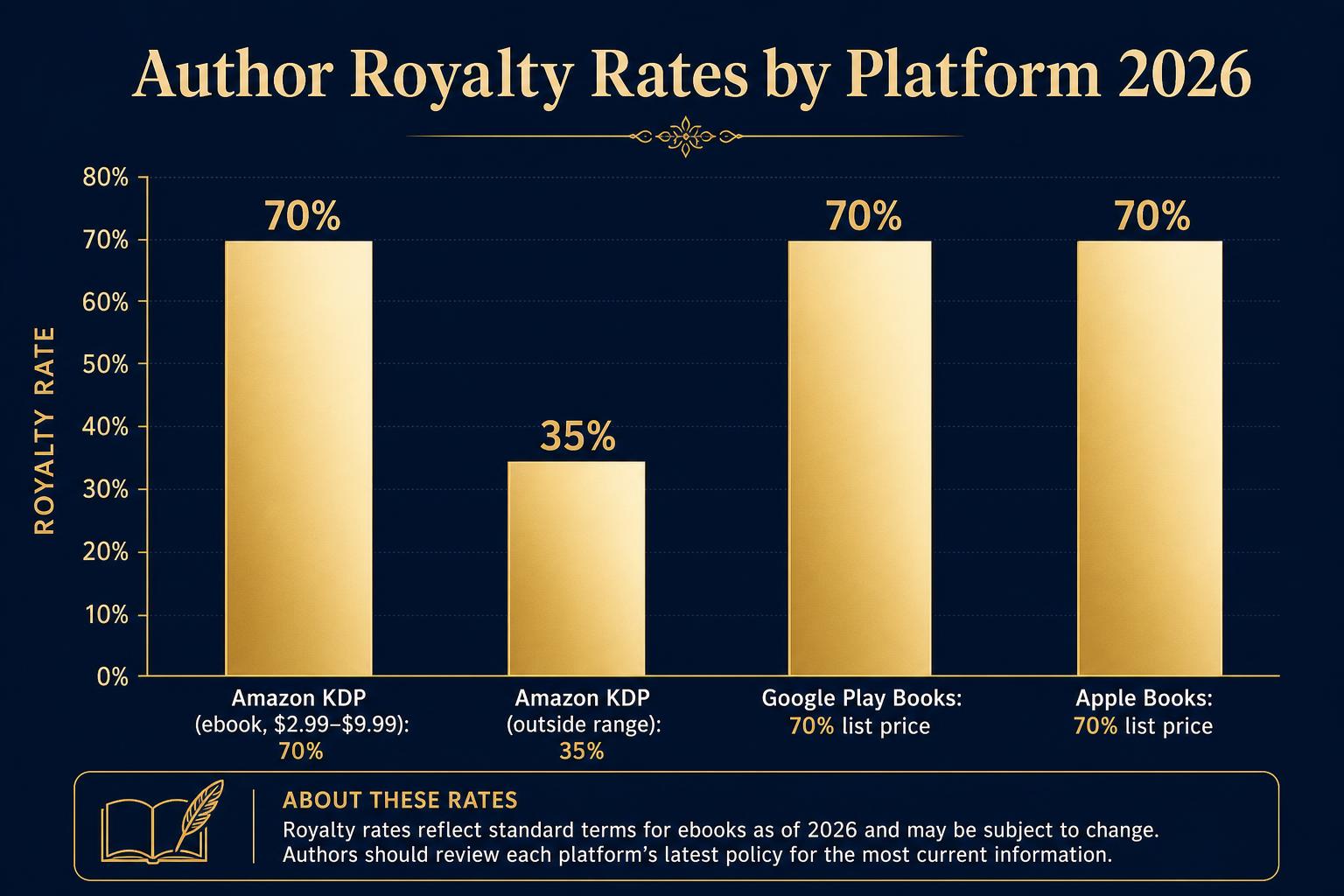
Every platform advertises "70%". None of them actually pay you 70% of the customer's price. Here is what lands in your bank account after the platform takes its share, on a ₹299 ebook (roughly $3.59 — squarely inside Amazon's premium royalty band — as of July 7, 2026 runs $2.99–$12.99, expanded from the previous $9.99 ceiling).
| Platform | Headline rate | What's deducted | You receive on ₹299 |
|---|---|---|---|
| Amazon KDP (in band) | 70% | Delivery fee (~₹2/MB) | ~₹205 |
| Amazon KDP (out of band) | 35% | None | ~₹105 |
| Google Play Books | 70% | Applies to list, not sale price | ~₹209 |
| Apple Books | 70% | None — flat | ~₹209 |
| Kobo Writing Life | 70% above $2.99 | None | ~₹209 |
Figures are illustrative for a ~1 MB EPUB at ₹299. Amazon's delivery fee scales with file size — image-heavy cookbooks lose more. Google routinely discounts list price; your 70% is calculated on the list you set, not the price the customer paid, which is why it can pay more than Amazon in practice.
Exclusive or wide? The single most expensive decision.
Enrolling in KDP Select locks your ebook to Amazon for 90 days at a time. In exchange you get Kindle Unlimited page-read royalties (~₹0.35 per page read in 2026), Countdown Deals, and free promo days. For genre fiction with a series — romance, thriller, LitRPG — KU readers are voracious and the math often works out. For everything else (non-fiction, cookbooks, academic and textbooks, literary, poetry), you will earn more over twelve months by going wide on Google, Apple, Kobo, and library platforms like OverDrive and Bibliotheca via an aggregator.
Direct vs aggregator: the trade-off in one paragraph
Uploading directly to each retailer takes longer, demands separate tax forms (W-8BEN for Amazon and Apple, a different one for Google), and requires you to track sales in four dashboards — but you keep 100% of the platform's payout. Going through an aggregator like Bookmundo, IngramSpark, or Lulu reaches 40+ stores from a single EPUB upload but skims 10–15% off the top. Our default at Itorzo: direct to Amazon, Google, and Apple; aggregator for everything else.
A realistic 2026 publishing checklist
- Edit the manuscript professionally. Self-publishing is not skip-the-editor publishing.
- Commission a cover designer who has shipped in your genre. Generic AI covers tank conversion.
- Get an ISBN only if you need one number across stores; otherwise take the free ones.
- Build a clean EPUB 3. Validate it with EPUBCheck before every upload.
- Open KDP, Google Play Books Partner Center, and Apple Books Connect accounts in parallel — verification can take 2–6 weeks.
- List on all three with identical metadata. Use the same title, subtitle, BISAC codes, and description.
- Pick an aggregator for the long tail. Upload once. Don't double-list anywhere you went direct.
- Price in INR for the India store and in USD for the .com store. Don't auto-convert.
- Launch with a pre-order on at least Apple Books and Google — both reward pre-order velocity.
- After 90 days, review sales by store. Drop the underperformers from your next title's launch plan.
India-specific notes
- Tax forms: Without a W-8BEN, Amazon and Apple withhold 30% of US royalties. With it, withholding drops to 15% under the India–US treaty. Submit it the same day you open the account.
- GST: Royalty income from foreign platforms is treated as export of service. You'll need a GSTIN once you cross ₹20 lakh in annual turnover; below that, an LUT keeps you out of the GST loop.
- Bank transfers: Amazon and Google pay in INR directly. Apple still pays in USD via wire — factor in your bank's inward remittance fee.
- Print: KDP Print ships paperbacks from US, UK, and EU plants — Indian buyers pay heavy import duty. For the India market, use Amazon's India-specific print partner or a local print-on-demand service like Pothi or BlueRoseONE.
How this compares to a global royalty snapshot
The numbers above are India-specific (INR payouts, ₹299 example price). For a side-by-side view of how Amazon, Google, and Apple stack up at the same $9.99 USD list price — and how the July 2026 KDP band change shifted the math — see our 2026 royalty rate comparison.
FAQ
Do I need an ISBN to self-publish in India?
Not on Amazon KDP — it issues a free ASIN. Most aggregators include a free ISBN. You only need to buy your own from the Raja Rammohun Roy National Agency if you want the same number on every platform.
What royalty does Amazon KDP pay Indian authors in 2026?
70% on ebooks priced $2.99–$12.99 (minus a per-MB delivery fee), 35% outside that range. The 70% band was expanded from $9.99 effective July 7, 2026. Paperbacks pay 60% of list price minus printing cost. Paid in INR once you cross ₹1,000.
Is Kindle Unlimited worth it?
Only if you commit to Amazon exclusivity for 90 days and write in a high-velocity genre with a series. For most non-fiction, going wide pays more over 12 months.